Inheritance Tax on Pensions 2027: What Families Need to Know
How the new pension inheritance tax rules could affect your estate, your beneficiaries and your long-term wealth planning.

For many families, pensions have traditionally formed an important part of retirement planning and passing wealth to future generations. However, significant changes to the UK's Inheritance Tax (IHT) rules will take effect from 6 April 2027, potentially affecting how unused pension savings are treated when someone dies.
Under legislation introduced through the Finance Act 2026, most unused pension funds and pension death benefits will be included in the value of a deceased person's estate for Inheritance Tax purposes.
This represents an important change for individuals with substantial pension savings, property portfolios or other assets.
At Rodgers Taxation, we specialise in inheritance tax and estate planning, helping individuals and families understand their tax exposure and make informed decisions about preserving and transferring wealth.
What Is Changing to Pension Inheritance Tax in April 2027?
Under the rules applying before April 2027, unused pension funds held within many discretionary pension arrangements can generally be passed to beneficiaries outside the deceased person's estate for Inheritance Tax purposes.
This has made pensions an important consideration within wider estate planning strategies.
From 6 April 2027, most unused pension funds and pension death benefits will be brought within the scope of Inheritance Tax, regardless of whether pension scheme trustees have discretion over who receives the benefits.
The change applies to deaths occurring on or after 6 April 2027.
It does not mean that every inherited pension will automatically result in an Inheritance Tax charge. The overall estate value, applicable allowances, reliefs, exemptions and the identity of the beneficiaries will remain important.
Which Pensions Will Be Affected?
The changes will potentially affect a range of pension arrangements, including defined contribution pensions, Self-Invested Personal Pensions (SIPPs) and certain defined benefit pension death benefits.
However, not every pension benefit will be included.
For example, death-in-service benefits payable from registered pension schemes are excluded under the new rules. Certain dependant's scheme pensions from defined benefit arrangements and collective money purchase arrangements are also excluded.
The treatment of an individual pension arrangement will depend on its structure and the nature of the benefits payable.
This makes reviewing pension arrangements alongside other estate assets particularly important.
Could Your Family Face a Higher Inheritance Tax Bill?
The inclusion of unused pension funds could increase the taxable value of an estate, particularly where an individual already owns significant property, investments or business assets.
The standard Inheritance Tax nil-rate band remains £325,000.
A further residence nil-rate band of up to £175,000 may be available where a qualifying home passes to direct descendants, subject to the relevant conditions.
For married couples and civil partners, unused allowances may also be transferable, potentially allowing qualifying estates to benefit from combined thresholds of up to £1 million.
However, these allowances are not automatic in every situation, and the residence nil-rate band is reduced for estates exceeding £2 million.
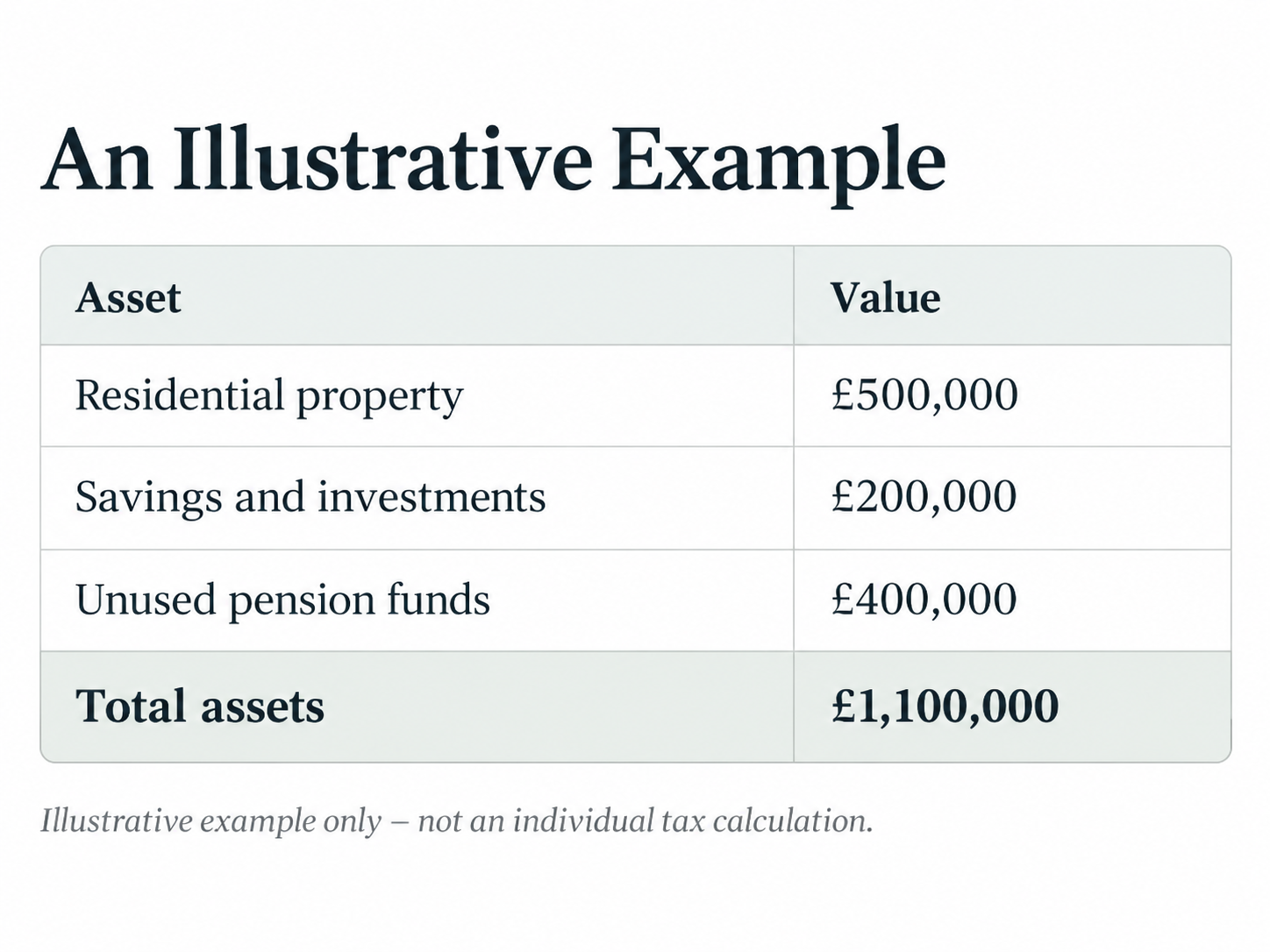
Before April 2027, assuming the pension was held in an arrangement outside the estate for Inheritance Tax purposes, the estate could have been assessed at £700,000.
From April 2027, the additional £400,000 of unused pension funds may become relevant to the Inheritance Tax calculation.
This could increase the taxable value of the estate and the eventual liability.
The precise outcome would depend on matters including debts, gifts, available allowances and reliefs, the beneficiaries, and the type of pension arrangement.
This example is illustrative only and is not an individual tax calculation.
What About Pensions Passed to a Spouse or Civil Partner?
The spouse or civil partner exemption remains an important consideration.
Where qualifying pension death benefits pass to a surviving spouse or civil partner, the normal Inheritance Tax spouse exemption may apply, subject to the relevant statutory conditions.
However, passing assets to a spouse does not necessarily remove Inheritance Tax considerations permanently.
When the surviving spouse or civil partner subsequently dies, their estate may include assets inherited earlier, potentially affecting the overall Inheritance Tax position.
Estate planning should therefore consider both individuals and the longer-term transfer of family wealth.
Can Inherited Pensions Be Subject to Both Inheritance Tax and Income Tax?
Potentially, yes.
The Inheritance Tax treatment of unused pension funds is separate from the Income Tax treatment of pension death benefits.
Broadly, the age of the pension holder at death can influence whether beneficiaries pay Income Tax when receiving pension benefits.
For example, where the deceased was aged 75 or over, inherited pension benefits are generally subject to Income Tax when paid to beneficiaries, depending on the form of the benefit and the recipient.
From April 2027, Inheritance Tax may also arise on the relevant pension value.
The legislation includes provisions to prevent the portion of pension benefits used to meet Inheritance Tax and associated interest from also being treated as taxable pension income.
Nevertheless, the interaction between the two taxes can be complex and should be assessed carefully.
What Should Families Consider Before April 2027?
The changes provide an important opportunity to review existing inheritance tax and estate planning arrangements.
1. Review the value of your estate
Consider your property, investments, savings, business interests and pension arrangements together.
An estate that currently falls below a particular Inheritance Tax threshold may be affected when unused pension funds are included.
2. Reassess existing inheritance tax planning
Strategies developed under previous pension rules may need to be reviewed.
Existing plans should be assessed against the legislation taking effect in April 2027, rather than assuming their previous tax treatment will continue.
3. Review pension beneficiary nominations
It is sensible to check that pension beneficiary nominations and expressions of wishes continue to reflect your intentions.
However, simply changing a beneficiary nomination will not necessarily remove a pension from the scope of Inheritance Tax under the new rules.
4. Consider the role of lifetime gifting and trusts
Lifetime gifts and trusts may form part of an effective wider estate planning strategy, depending on individual circumstances.
However, gifting and trust arrangements are subject to detailed tax rules, including potential Inheritance Tax charges, anti-avoidance provisions and reporting obligations.
There is no single approach suitable for every family.
5. Seek specialist tax advice
Individuals with significant pension funds, family businesses, investment properties or existing trust arrangements may benefit from a coordinated review of their estate planning position.
Any decisions about pension withdrawals, gifts or changes to investment arrangements should also take account of retirement income needs and other tax consequences.
Who Will Be Responsible for Reporting Inheritance Tax on Pensions?
The changes will also affect the administration of estates.
From April 2027, personal representatives will generally be responsible for identifying relevant pension benefits, reporting them for Inheritance Tax purposes and arranging payment of any tax due.
Pension scheme administrators will have obligations to share relevant information.
This means executors may need to obtain details from several pension providers before finalising an estate's Inheritance Tax position.
Accurate estate valuations, complete records and communication with professional advisers will become particularly important.
Why Specialist Inheritance Tax Planning Matters
Inheritance Tax planning involves more than simply understanding the value of an estate.
The interaction between pensions, property, trusts, gifts, family businesses and available tax reliefs can create complex considerations.
At Rodgers Taxation, we provide specialist advice on inheritance tax liabilities, lifetime tax planning, gifts, UK and offshore trusts with UK tax implications, estate valuations and inheritance tax reporting.
Our approach is to consider the wider financial and family circumstances, identifying relevant tax implications and ensuring planning decisions are supported by the applicable legislation.
Review Your Inheritance Tax Position with Rodgers Taxation
The April 2027 pension changes may have a significant impact on some families, particularly those with substantial unused pension funds and other assets.
Reviewing existing arrangements before the new rules take effect can help individuals better understand their potential exposure and consider whether their estate planning remains appropriate.
For specialist Inheritance Tax advice, contact Rodgers Taxation to discuss your circumstances.
Rodgers Taxation Ltd
Website: https://www.rodgerstaxation.co.uk/
Email: latha@rodgerstaxation.co.uk
Telephone: 07943 805130
Important Tax Information
This article is provided for general information only and reflects UK tax legislation and published HMRC guidance available as at 15 October 2026. It is not personalised tax, legal, investment or pension advice. Tax treatment depends on individual circumstances and may change. Professional advice should be obtained before taking action. Rodgers Taxation provides specialist tax advice; regulated pension or investment recommendations, where required, should be obtained from an appropriately authorised financial adviser.